
Polymarket Is Winning Prediction Markets. Capital Efficiency Is Next

Polymarket is currently leading the on-chain prediction market space, with over $23 billion in cumulative volume as of November 2025 and a record $371 million traded in a single day during the 2024 US presidential elections, according to @datadashboards on @Dune. The platform has attracted substantial capital, fueling growth that extends beyond election hype into a wide range of event-driven markets. Yet, as challengers such as Kalshi, Limitless, and Opinion Market intensify the competition, @Polymarket faces mounting pressure to maintain its edge.
Next Moves for Growth
With competition rising, Polymarket is working to accelerate innovation through its @PolymarketBuild grants program. Builders are exploring new features, including:
Lending against your positions
Leveraged bets
Advanced analytics
While these initiatives can unlock new utilities for users, Polymarket's next priority should be capital efficiency. By deploying idle USDC more productively, Polymarket can both reinforce its position and unlock new sources of revenue for the protocol and its community.
Current Capital Landscape
Polymarket’s ecosystem has two main components that hold USDC: open interest and user proxy wallets.
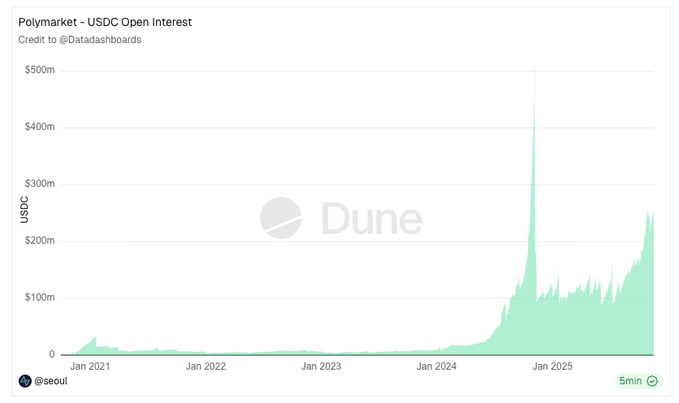
Open Interest represents the total USDC locked in unresolved markets. These funds have been committed to wagers that have yet to settle. As of November 2025, open interest hovers around $240 million with an November 2024 peak of $512 million.
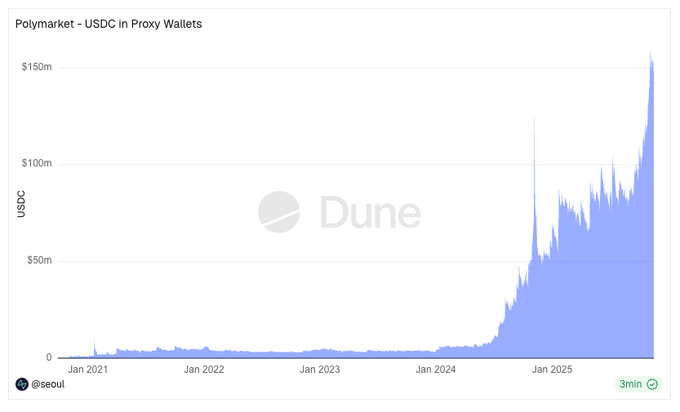
User proxy wallets, required for participation, hold an aggregated USDC balance of $155 million across more than 600,000 unique wallets.
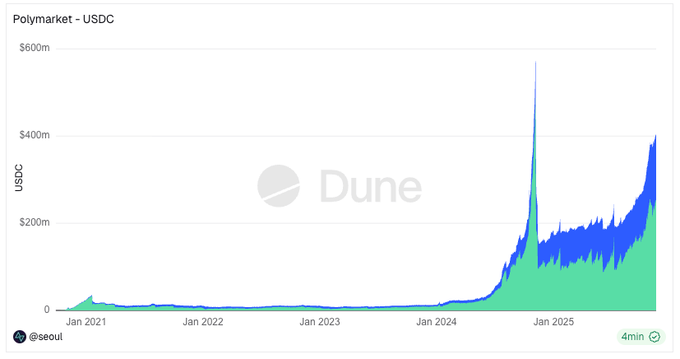
In total, over $402 million USDC currently sits idle in Polymarket’s ecosystem. This capital is not generating yield for either users or the protocol, and the total has surged 106% YoY, highlight a significant but untapped opportunity.
Asset-backed securities (ABS), which include related terms such as securitization, structured products, and structured credit, refer to financial instruments backed by pools of income-generating assets such as auto loans, mortgages, or credit card receivables. These assets serve as collateral, and the cash flows generated are allocated to investors according to a “waterfall” structure that defines the order of payments. Senior tranches are paid first, followed by mezzanine tranches, and then subordinated or equity tranches. Lower tranches absorb losses first and therefore carry higher risk, but also offer the potential for greater returns.
Unlocking Idle Capital
Idle USDC in Polymarket’s ecosystem is a missed opportunity. To unlock its value, Polymarket could pursue strategies such as:
Protocol stablecoin: Launch a protocol-native stablecoin, either independently or via partnership with projects like @m0. This would allow Polymarket to accrue yield from collateral.
Run a Hyperliquid-style USDC competition: Invite stablecoin providers such as @ethena_labs and@SkyEcosystem to bid for exclusive partnerships and channel incentives and yields back to the protocol.
Even with a modest 2% yield, Polymarket could unlock $8 million in annual revenue that could fuel both protocol development and potential user rewards post-TGE.
Closing Thoughts
As prediction markets mature, optimizing for capital efficiency may become a key competitive differentiator for Polymarket. Activating idle balances can generate sustainable revenue streams, attract new users, and create a more vibrant ecosystem for both traders and builders. In a landscape where every DeFi protocol is racing to maximize asset productivity, Polymarket's next phase of growth could be defined by how it activates this underused capital base.